


Two weeks ago, I wrote about Connecticut’s new AI law and how it concentrates power in the state Attorney General’s office. I left something out.
The most interesting sentence from the bill didn’t make it into the law.
The bill that came out of committee this spring laid out something simple. If an AI companion harmed you, you’d be able to sue. Parents could sue if the user was a child. Families could recover actual and punitive damages, plus the state could add civil penalties up to $25K per violation. We know it was in the bill by March 3, because that’s when the industry wrote a letter about it.
Big Tech didn’t want that in the bill. NetChoice, the trade group for Google, Meta and others, told the legislature in March which part worried it most: the private right of action for actual and punitive damages, which their letter said “ensures that operators will implement the most restrictive age-verification measures available rather than risk liability.”
Through early April, the lawsuit was still in the bill.
Then it was gone. The Senate adopted the amendment on April 21 and passed the amended bill on the same day. The lawsuit language was removed and the kids' section now says violations "shall be enforced solely by the Attorney General."
Then the House concurred on May 1, and Governor Lamont signed it into law a few weeks later. The word “punitive” was nowhere in the final product.
Under the new law, essentially no one can directly sue an AI company.
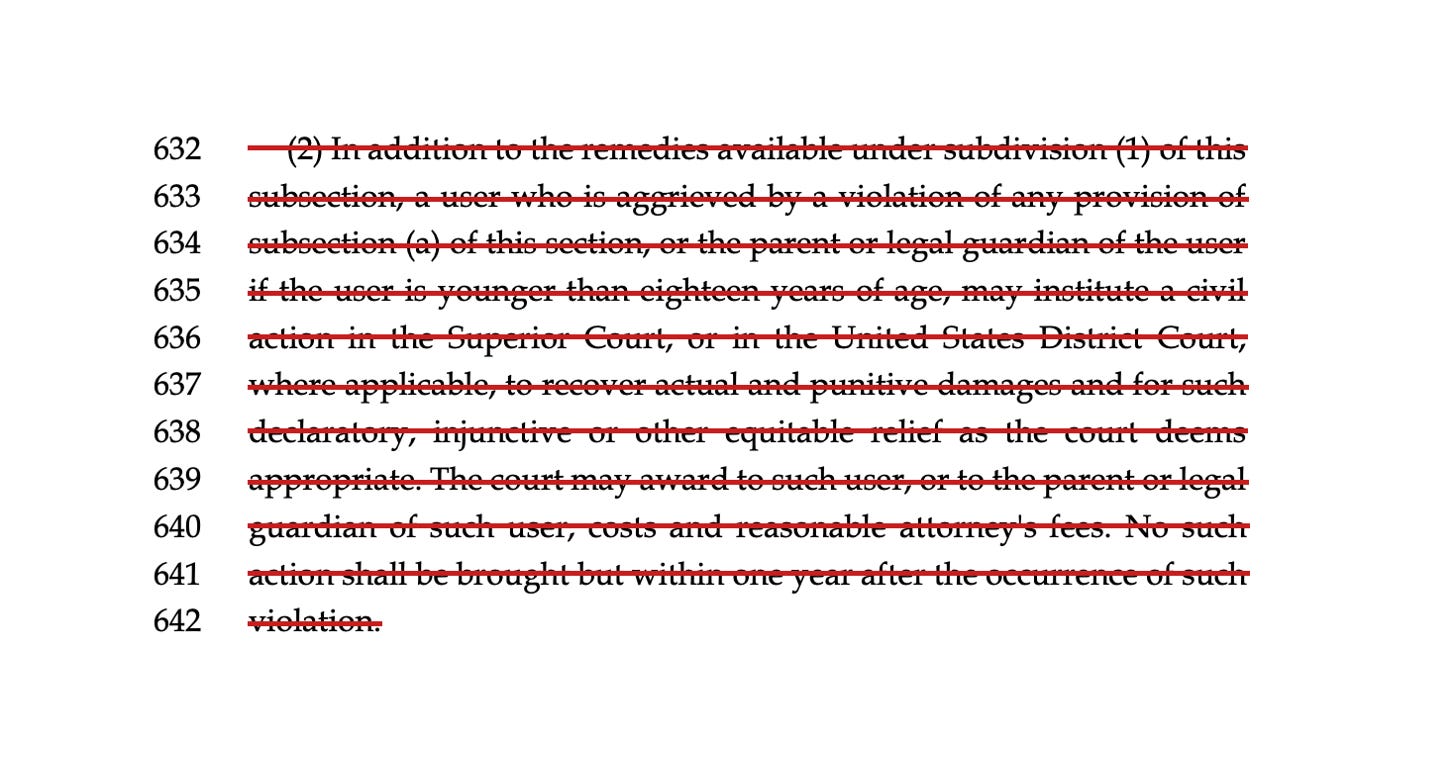
If a chatbot manipulates you and you’re an adult, you can’t sue under this law. If a machine screens you out of a job and nobody tells you, you can’t sue under this law. If a company strips the watermark off synthetic content, you can’t sue.
And now: if an AI companion hurts your kid, this law doesn’t allow you to file a private lawsuit. Your only remedy under this law is the state Attorney General.
A family in Connecticut can still sue the old way: product liability → negligence → plus years of fighting in court → maybe a sealed settlement at the end.
Everything will now run through the state Attorney General’s office. A budget analysis done by the state says the office needs 7 new hires to handle it: 3 more lawyers, 2 IT analysts, a program manager and a paralegal, about $483K in the first year.
This is the enforcement plan for the entire AI industry in Connecticut.
Why does one sentence stand out so much? Because regulations tell a company what it can’t do. Lawsuits decide what happens when it does it anyway.
Look back to January. Google and Character.AI settled lawsuits brought by parents in Florida, Colorado, New York and Texas. The Florida case was a mother whose 14-year-old son died by suicide after months chatting with a chatbot. The terms of that settlement were never disclosed.
Compliance isn’t cheap, but the expense is limited and very predictable. These tech companies have the cash to budget for warning labels and age checks.
They hate litigation, though. It means discovery, chat logs read aloud in courtrooms and a jury deciding what the company knew and didn’t know.
The cases just disappeared. No trial, no verdict, no precedent, and the question of whether these companies are responsible is still open.
And no federal law will fill this gap. The top bill in Congress belongs to Connecticut’s senior senator. Senator Blumenthal spent 20 years as the state’s Attorney General suing companies on behalf of people who couldn’t afford the lawsuits themselves. His AI bill carries criminal fines up to $250K per offense. It doesn’t put a family in front of a jury.
Other states went the other direction. California’s companion-chatbot law lets families sue. Oregon’s law has no attorney general enforcement at all, only private lawsuits. Connecticut had that sentence in its bill this spring, but took it out.
NetChoice’s letter was sent on March 3. The lawsuit came out of the bill on April 21. We don’t know for sure that one caused the other. But we know the order things happened.
If an AI companion hurts a child in Connecticut, the family is back where the settled families started.
For 7 weeks this spring, the bill said something different.