


Connecticut’s new AI law is being interpreted mostly as a corporate compliance story. The bigger move is more low key: the legislature just handed Attorney General William Tong an unusual amount of discretionary power over how AI operates in the state.
Public Act 26-15, signed earlier this month under the bland title An Act Concerning Online Safety, runs 74 pages. It regulates frontier AI models, hiring tools, AI companions for minors, synthetic media and subscription chatbots.
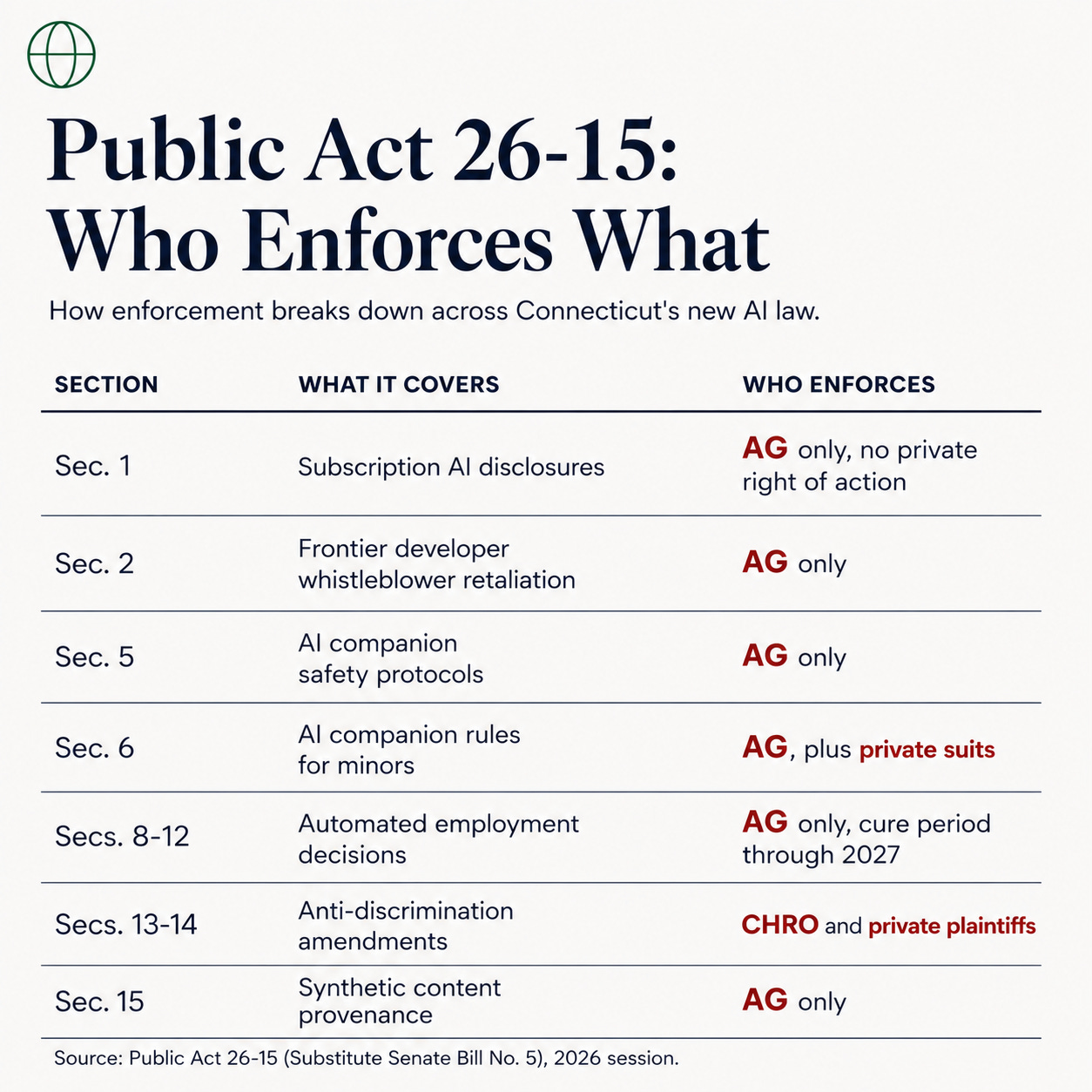
*See below.
Almost every part of the bill that has teeth runs through one desk.
An asset manager in Stamford using AI to screen every job applicant before a human even sees a résumé. A 14-year-old in New Haven talking to the same chatbot after midnight. A synthetic video or image used in a campaign mailer without the digital watermark that the law now requires.
Under Public Act 26-15, one man gets to decide what to do about them.
Connecticut isn’t the only state to centralize AI enforcement within the AG’s office. Colorado does something similar, as does Texas. What’s unusual about CT is the breadth: one bill and one office covering frontier models, chatbots, hiring tools and AI/synthetic media. California is the outlier the other way, spreading authority across the AG, the new CA Privacy Protection Agency and a handful of laws that let regular citizens sue directly.
Congress has been largely absent on AI regulation. The FTC has been active on AI but mostly on narrow cases regarding deceptive marketing. In this world, CT consolidated power and handed most of it to Tong.
Tong indicated earlier this year that his office already saw AI as part of its consumer protection and civil rights mandate. Public Act 26-15, which state Senator James Maroney shepherded through three legislative sessions to get passed, gives that posture teeth.
The short-term stuff is obvious. He’ll have to figure out what “related to AI” really means when companies start filing WARN notices with the Department of Labor in October. He’ll have to decide whether to go after corporations using AI to hire people or wait and see what cases emerge.
What gets less attention is what happens after Tong. He won’t be AG forever and he’s on the shortlist for any bigger statewide office that opens up. Whoever comes next inherits a portfolio that didn’t exist before May 1.
The effects will show up in CT residents’ lives long before most of them ever hear about “Public Act 26-15.”
October 1 is a big day. It’s when the first WARN notices with an AI disclosure box can start being filed.
A policy team at UConn owes a workforce impact report by January 1. The AI working group’s initial meeting is required by August 31. Watch those moments to see what Tong’s office does… and what it doesn’t.
William Tong has a new job. It’s worth watching what he does with it.
*Update: the graphic originally said Sec. 6 allows private suits, following early legal analyses. The enrolled text says violations "shall be enforced solely by the Attorney General," and the bill's explicit private lawsuit was removed before passage.