


There’s a question no one in politics is asking right now. Once you hear it, it’s hard to stop thinking about.
What happens when the economy keeps growing… but fewer people are needed to run it?
And I don’t mean in some far off, fantasy, sci-fi sense. I mean it in a very real, measurable way. You can already see it in hiring trends, earnings reports, and how work is quietly being reorganized right now.
Output goes up, revenue holds and over time, the number of people required to sustain that output starts to drift downward. It’s not a hypothetical anymore, it’s a direction.
The discourse on AI is stuck in two places that don’t really connect.
On one side, there’s the optimists who talk about AI tutors for every child, exponentially faster drug discovery and a more productive economy. Some of this will be true.
On the other side, you’ve got the doomers. Job loss, misinfo/disinfo, moving towards a world that no one can define but everyone gestures towards.
Both sides are reacting to real things. But neither is talking about the structure of the economy itself and that’s where it’s starting to get uncomfortable.
Whether AI is “good” or “bad” avoids the massive question underneath it: what happens to the economy when it no longer depends on us, people, in the same way?
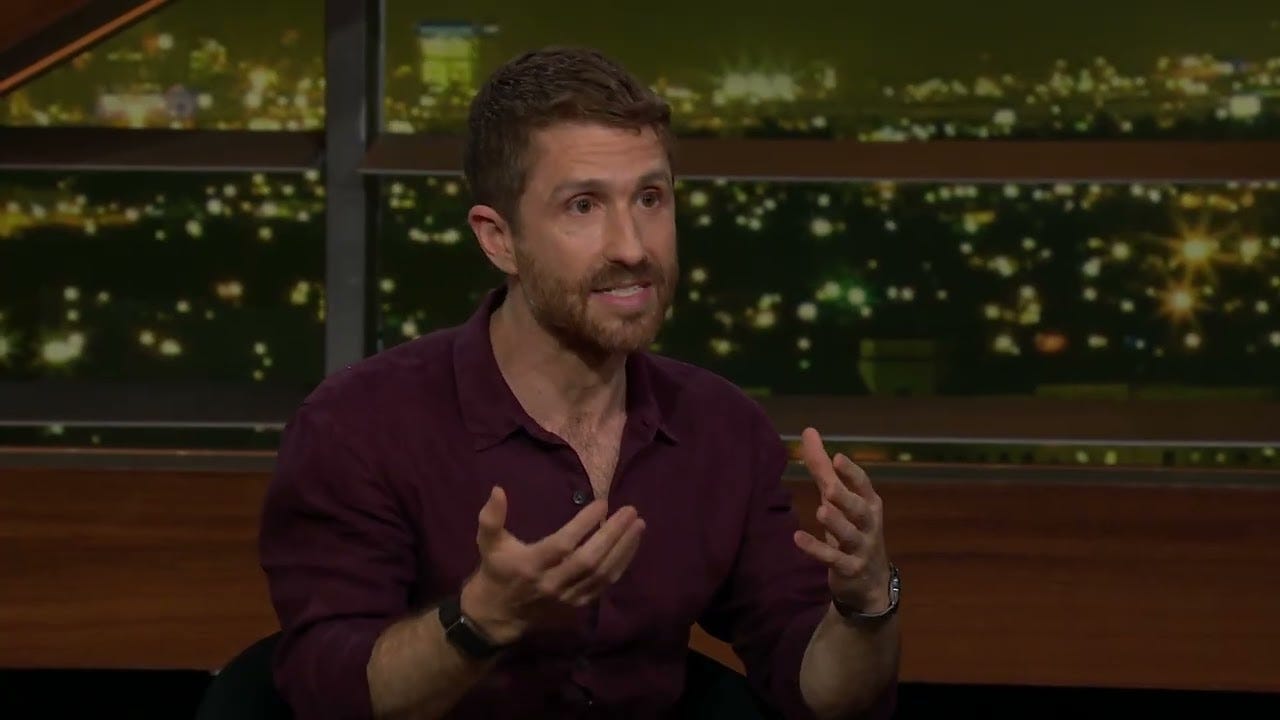
Last week, Tristan Harris was on Bill Maher’s show and got closer to this question than most coverage out there.
Maher asked what most of us assume. Isn’t this just about money? Subs, ads, the same old incentives we saw during the advent of the internet and social media.
But Harris pushed back and his answer is worth sitting with:
“If you get all the ChatGPT subscriptions, that doesn’t add up to paying off the amount of debt that they’ve taken. If you get all advertising in the world, that wouldn’t pay off the amount of debt that they’ve taken. The only thing that justifies the amount of investment… is to build artificial general intelligence… to be able to replace every human worker in the economy.”
AI is going to be (and already is) a huge business. Subs, ads, enterprise… all of this is real.
What Harris is getting at is that even this gargantuan business model might not be enough. The scale of investment is so enormous and the returns investors are expecting don’t line up with the productivity gains and improved software tools that are on the horizon.
And once we take that seriously, the implication is straightforward. They’re not just building technology to help people work. They’re building systems that reduce how many people are needed in the first place.
This isn’t a conspiracy. This is where the incentives lead.
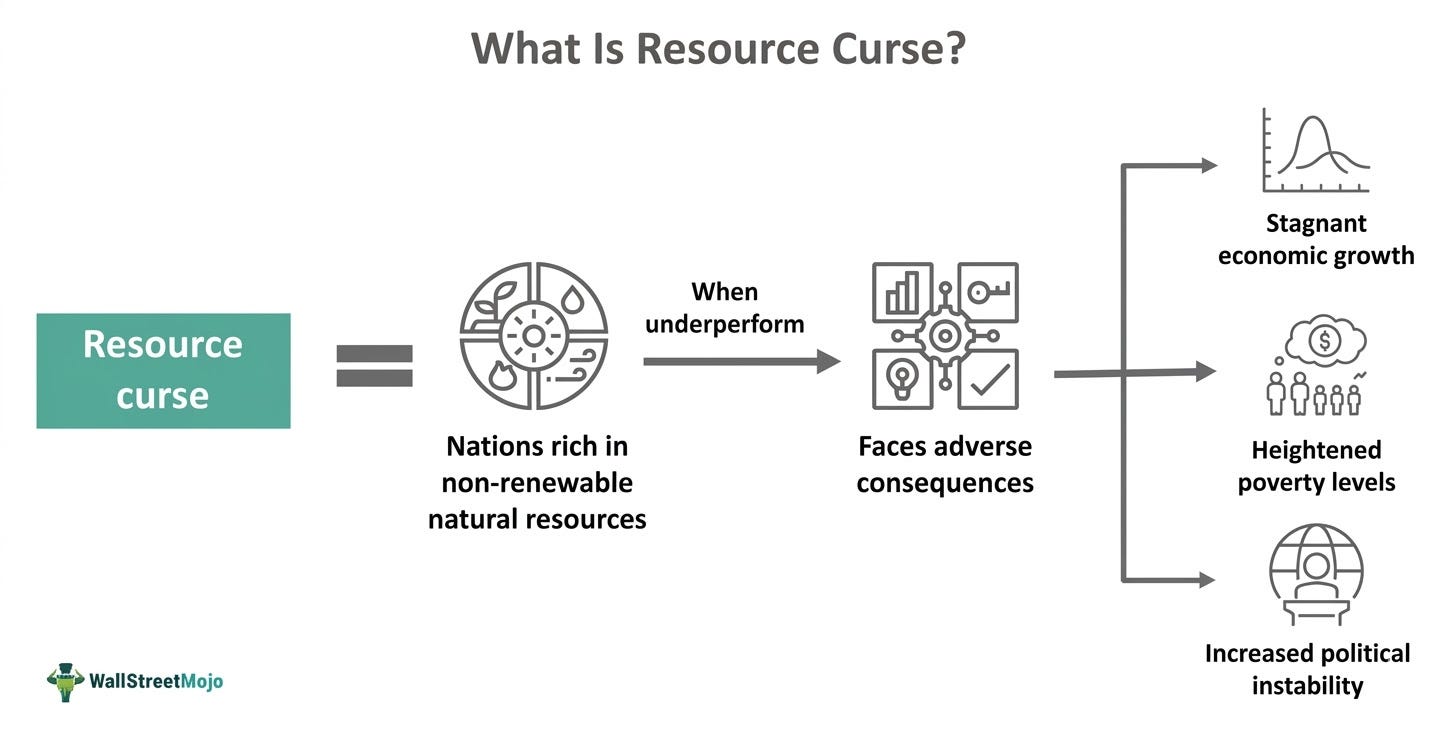
There’s an old concept in economics called the resource curse. You often see it in countries rich in oil or minerals. The wealth is real, oftentimes massive, but it changes how their economies work. Instead of depending on people to generate value, the system depends on extraction. Governments invest in infrastructure and production, not in their people. Incentives always win.
Over time, the relationship between the economy and people moves. Slowly at first, then quickly.
AI creates a version of this dynamic for advanced and mature economies. You could call it an intelligence curse. When more of your economic output comes from machines vs. people, the incentives move in that direction. It moves towards energy, infrastructure and compute. And moves away from labor.
What does this look like in practice? It won’t look like a collapse or a sudden wave of unemployment that we can point to.
It looks like companies getting more efficient, producing more with fewer people. Margins improving and growth continuing to go up.
At the same time, headcount goes down. Entire categories of work get compressed. Fewer new roles open up to replace the old ones.
Corporate tax revenues can hold up in this environment. But income tax is another story. Eventually, that will start to soften and the effects will show up locally.
There will be less municipal spending, property values go down. It’ll be small shifts at first, followed by more noticeable ones.
It’s a strange kind of divergence. The economy looks healthy from the top down but feels different on the ground. The economy works, but fewer people do.
This part is easy to miss. This isn’t just about being unemployed. It’s about losing your place in society and in how the economy functions.
Where might this show up first?
Finance, insurance, law, media, consulting. These kinds of roles have been seen as stable for a long time. High-skill, high-wage jobs that sit at the center of how the modern economy runs.
And people in these roles are supporting local systems all around them: housing markets, public schools, small businesses, local tax revenues.
The parts of the economy that we think of as the strongest right now might actually be the most exposed.
If you look at how policy is responding, it’s mostly focused on the surface. Privacy rules, deepfakes, guardrails around how AI is used. All of this matters, but it just doesn’t touch the core issue.
The real shift is happening underneath. It’s about how output relates to labor. How growth relates to real people. I’ve yet to see a plan for this. Not on the state level or federally.
There’s no playbook we can cite for when a tax base built on human income starts to fade away from the economy generating that income.
Currently, we’re mostly reacting to what AI does and not preparing for what it changes.
Maybe things will move slower than it feels. Maybe there are limits that we’re not seeing yet that keep more people in the system. I don’t know.
But the direction isn’t subtle. This isn’t a dramatic “machines take over” story… it’s much quieter than that. This is about incentives shifting, bit by bit, away from real people.
Once this shift sets in, it’ll be nearly impossible to unwind it.
The economy probably won’t break. It’ll just stop needing all of us.