


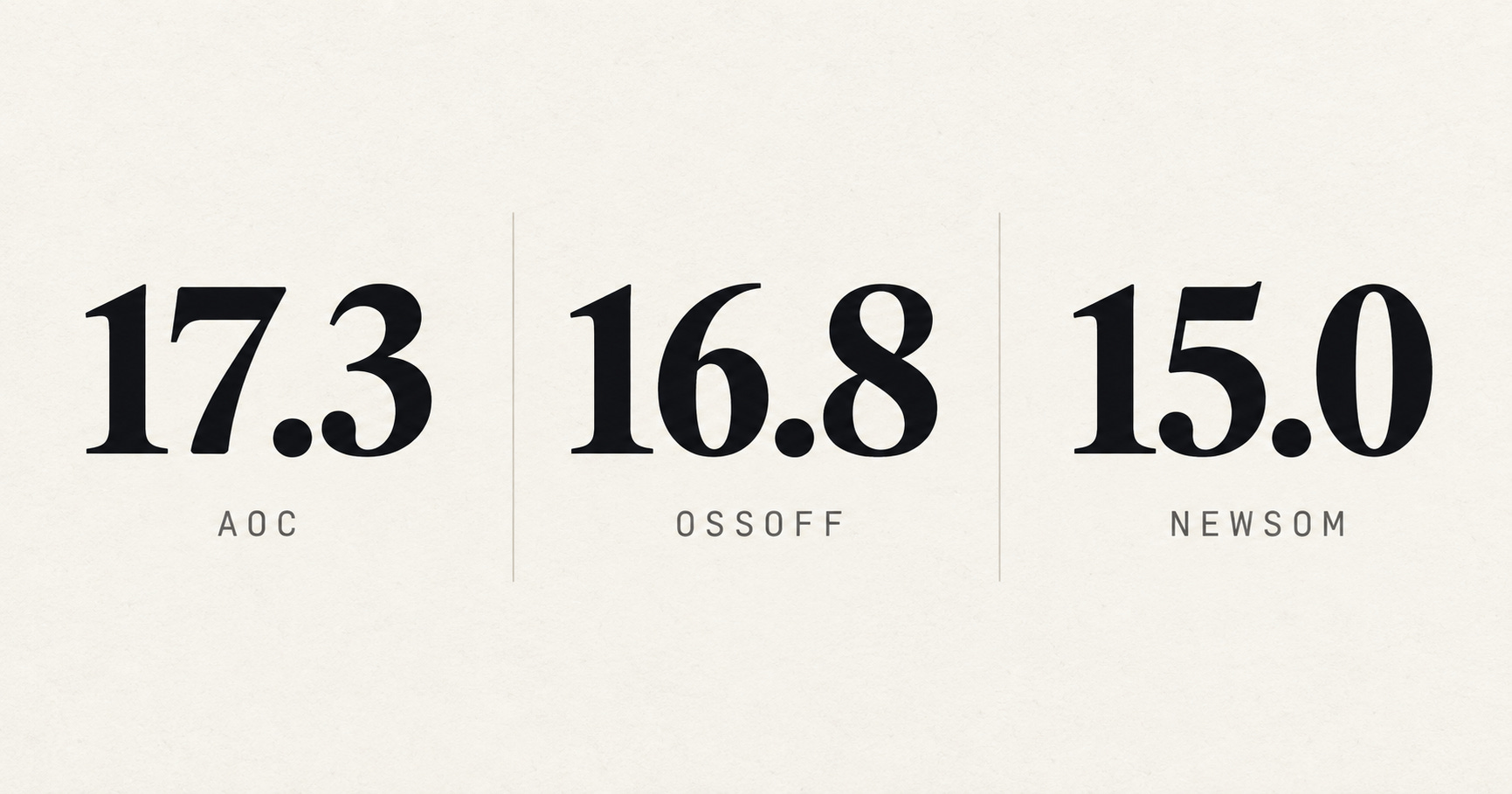
A few months ago I built the 2028 Machine. It had Gavin Newsom at 23 cents on Kalshi and Polymarket, and AOC and Jon Ossoff both around 10 cents. The combined market now has AOC at 17.3, Ossoff at 16.8 and Newsom at 15. Newsom has lost a third of his value over the summer and to be honest, I’m surprised people aren’t buying up the shares.
Voters aren’t buying anyone yet.
Ossoff has been saying repeatedly that he’s not running for president in 2028 but the markets have him at 68% to run anyway. He’s the most expensive candidate to buy on Kalshi right now with the draft-Ossoff machine doing some real work. I described this scenario in June and now it’s happening in the real world. The senator’s denials don’t move the market with most traders remembering Senator Obama in 2006 telling Tim Russert that he wasn’t going to run in 2008. (Spoiler alert: He changed his mind.)
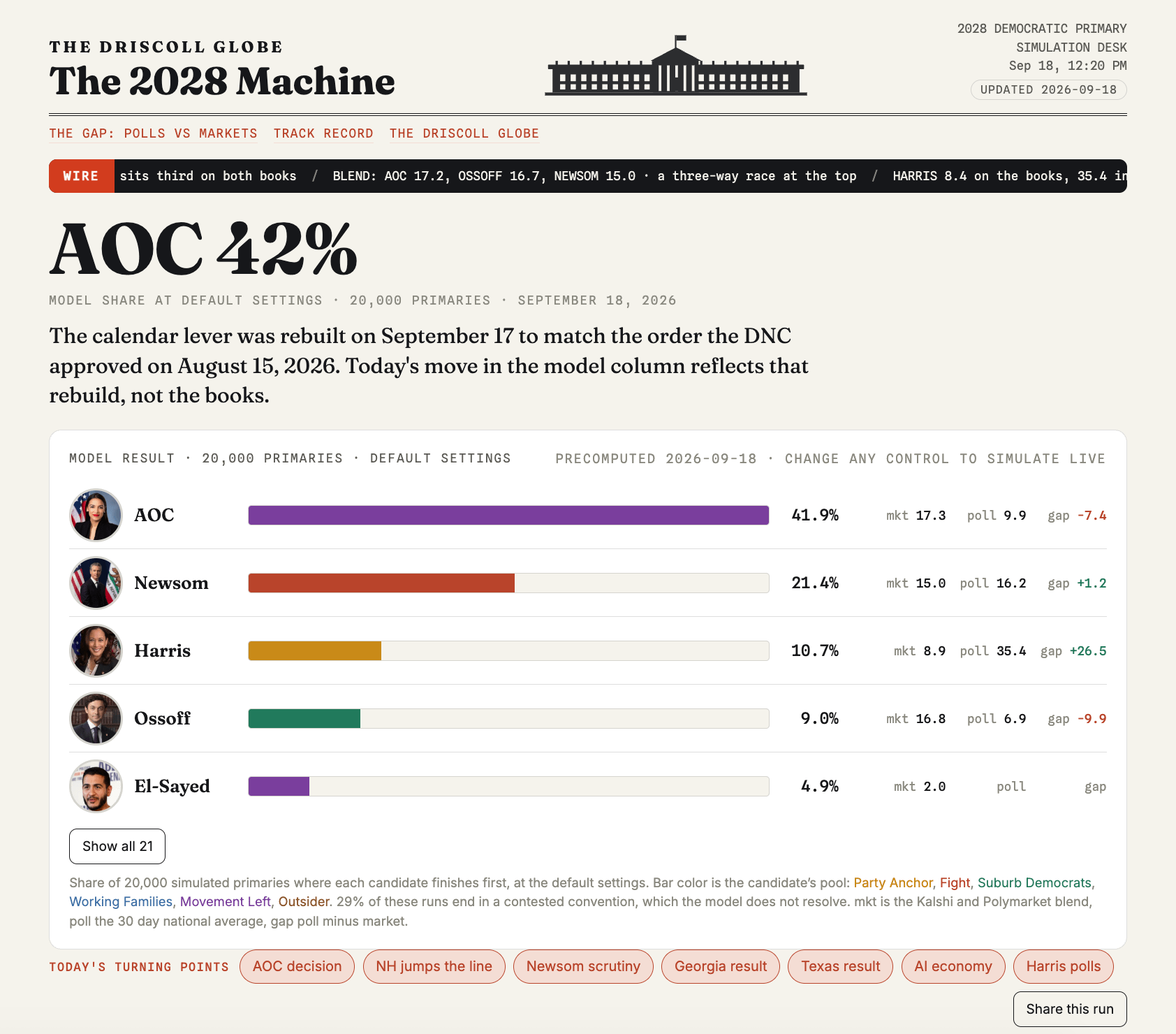
I trust the money over the polls and the prime example of this is Kamala Harris. Her polling average is 35.4% but the market only has her at 8.9% to win the nomination. That 26.5-point gap is the biggest discrepancy of anyone in the field. This 27 point gap is the biggest discrepancy of anyone in the field and I built a poll layer in the model as a display vs. being an input. Just like in previous cycles, the polls measure name recognition and typically don’t help tell us who will get nominated.
I’ll admit, I got something wrong in the last published version of the model. I had just 4 coalitions in the party but now I think there are at least 6. You may remember the populist bucket in the first version of the model. Now every candidate has a main coalition and a secondary one. When a candidate quits or doesn’t run, their support gets funneled to the closest coalition instead of the closest ideology.
Over the summer, the DNC made a major change to the calendar and now South Carolina will be the first to vote on January 22, 2028. Then Nevada goes, New Hampshire follows on February 8th and New Mexico, Michigan and Virginia complete the first phase.
The calendar did one thing I didn’t expect. The market says Pete Buttigieg has a 91% chance of running, more than anyone else. In my simulations he now wins 3 times every thousand scenarios. He did way better in a “retail” calendar with Iowa and New Hampshire leading off the process. Iowa was pushed out of the early window and New Hampshire is now later. That’s where Pete was going to get his oxygen. He’s the biggest loser of the DNC’s calendar decision.
Which brings me to a candidate that the model loves. It surprises me every time he wins a simulation.
Ro Khanna is priced 13th in the markets at around 1.7% but he finishes 6th in my simulation. I’ve searched for the bug but there isn’t one. 2 things are driving this result. Ro is the most theme-sensitive candidate in the field, so if the election is about AI and work, that boosts him way more than anybody else (he’s the congressman from Silicon Valley who’s at war with Big Tech). And Ro inherits a lot of the left in scenarios where AOC doesn’t run. The energy has to go somewhere and there’s more in that part of the party by far.
6 months ago, I had AI dominating the election as a hypothetical, one setting among four. But after the last few weeks, it isn’t hypothetical anymore. For example, Connecticut’s AI layoff notice requirement goes live October 1 (I’m going to be reading those filings all fall). I wouldn’t be surprised if the model is onto something and Ro surpasses expectations in 2028, especially if AOC runs for US Senate instead.
I do disagree with the current model.
I think Newsom wins the nomination in 2028. The market has him down big and my model hits him hard when scrutiny lands. I think both are wrong. The market can price attention and news cycles, but it can’t price 20 years of practice at holding a coalition together with a bunch of people who don’t like you. Newsom has governed our largest state as a relative moderate with a legislature to his left and an activist base sniping at every moment. His whole job has been working with them vs. winning arguments against them.
Newsom was asked about this in July and said he was “for addition, in the spirit of academia, not for subtraction.” Last week, he refused to put distance between him and DSA and said the socialist label was just… a label. He says these are voters he intends to keep. Most of the field is going to give DSA the heisman and spend the primary going on and on about what they’re not. Newsom won’t and the market has him at 15 cents partly because it doesn’t know how to price that. We’ll know more in November.
I also think he’s the best communicator in this field and a lot of readers will see what I mean next year.
There are a few pending items. We don’t know if AOC will run for the White House or Schumer’s seat. Ossoff is still saying he won’t run. The country still doesn’t know what the 2028 election will be about. And the calendar, the one June variable that’s settled, hurts the retail candidates and helps the church vote.