


Connecticut’s new Republican nominee for governor has built his campaign on one promise: he’ll cut your electricity rates by 20%, with eliminating the public benefits charge as the centerpiece.
For about 20 years, Connecticut hid about a billion dollars of spending inside your electric bill. A 2023 bipartisan law, which Fazio co-authored, forced the utilities to print it as its own line: the public benefits charge, which has run $50 to $60 a month at peak on a typical Eversource bill, close to a fifth of what you pay.
Bringing that into daylight was a genuine public service. Then he built a campaign promise on it. Fazio says he’ll eliminate every hidden tax in your electricity bills and cut rates 20%. His math holds: Getting rid of it would lower the line you pay to the utility.
Here’s the number he won’t give you.
That line isn’t one thing. It is about more than 50 programs: a long-term contract to buy nuclear power, energy efficiency, clean power procurement, help for families who can’t afford their bill and the unpaid bills the rest of us have to cover.
Hardship programs and unpaid bills make up nearly a quarter of Eversource’s public benefits charge and 45% of UI’s. That’s not a subsidy you can just switch off. It’s aid to households that can’t afford it and debt already owed. You can’t wipe it off a bill, you have to move it somewhere else.
Watch out for the word “eliminate.” Fazio’s actual plan is to end some programs, phase out others, and move the ones he likes to the regular state budget. Where they’d be up for debate every two years.
Fazio’s supporters will say moving the charge to the income tax is fairer, and they have a point. But fairer isn’t gone. Most of the 20% isn’t being cut, it’s just being moved. The money has to come from somewhere.
The real question isn’t the 20%. It’s who pays for it once it lands in the budget.
He hasn’t put any numbers to it and that is the hole at the center of the plan. To see what a billion dollars means in the state budget, look at the fights in Hartford over just tens of millions: $40 million in emergency aid in 2025 for a special education crisis, a Medicaid rate increase cut from $75 million to $15 million.
Fazio wants to move close to $1B into that fight. And here’s the catch. Connecticut has spending caps, the fiscal guardrails from 2017 that Fazio himself has championed for years. A billion dollars of new spending can’t slip in under those caps. Something has to give, but he won’t say what.
There’s one cut he does name, and it proves the point. Last year he co-authored Senate Bill 4, the omnibus energy bill signed as Public Act 25-173, which cut the charge by about 10%.
A clean example is the nuclear credit. On May 1, bills dropped around $30 a month for Eversource customers and $34 for UI, because the public benefits charge fell so far that it flipped into a credit. The driver was CT’s fixed-price contracts with Millstone and Seabrook, which have returned about $450M to ratepayers over the last 2 years.
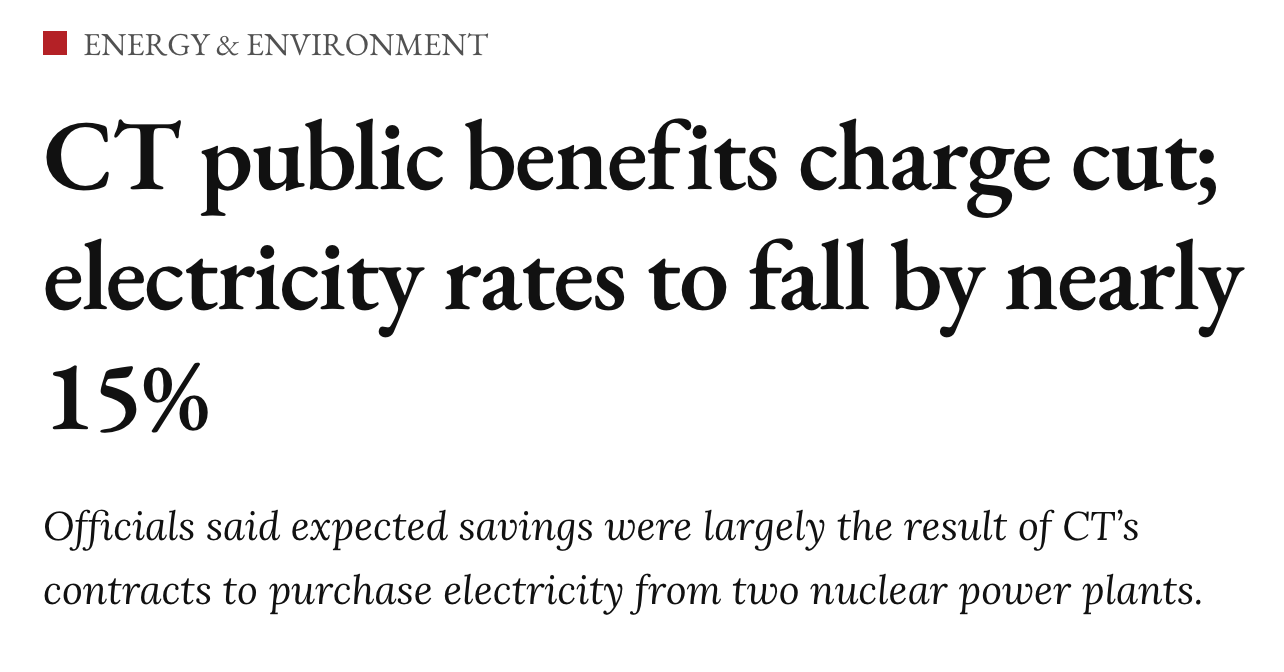
Fazio wants to keep those contracts. He likes nuclear power, and that’s good. But that credit reaches customers through the very charge he wants to get rid of. If the public benefits charge goes away, does the $450 million windfall flow back to ratepayers, or does it land in the General Fund (the state’s main checking account)? His plan doesn’t say.
So here’s the ask… Name the programs that you’d cut. Plainly say that the charge is being moved, not eliminated. What will happen to the nuclear credit? What number goes up when this one comes down?
In a June 2 op-ed introducing himself to Connecticut voters, Fazio repeated the promise. He’ll eliminate every hidden tax and cut rates 20%. He had plenty to say about the laws he’s passed and the taxes he blames on Lamont. He didn’t say what his plan would cost.
Fazio calls it eliminating the charge. It’s really moving it, and he still won’t say where.
Fazio's campaign did not respond to a request for comment.
Keep at it Kevin. Great stuff!