


On Friday, Greenwich First Selectman Fred Camillo called on the State of Connecticut to put an immediate moratorium on zoning mandates for all 169 municipalities across the state. His press release and a Greenwich Sentinel op-ed lay out the explanation, in his words: “The burdensome housing mandates that have been placed throughout the State of Connecticut have now taxed our infrastructure to the point that we can no longer keep up.”
What led to this, per the release, was Camillo “recently discovered that Connecticut Natural Gas does not have the infrastructure to meet the demands of new and expanded housing in Greenwich,” with “similar issues” coming up in talks with Aquarion, the water company.
To freeze zoning mandates across the state is a big ask, and before the presser I asked his office to show the proof. Would they release the correspondence from CNG and Aquarion or at least identify the communications the release referenced? Ken Borsuk, executive assistant to the First Selectman, answered in just two sentences. “There are no documents. The meetings were held in person.”
So the First Selectman has no paperwork from the conversations that set all this in motion. What he has is his own telling, from his most recent newsletter: “Recently I was very surprised to hear from some neighbors of mine who were doing modest tear downs and expansion of their homes in Greenwich. They had been told by Connecticut Natural Gas that they did not have the capacity to provide service for these larger homes. I spoke to CNG and they confirmed this is an issue throughout the State and we were the first to bring attention to it.”
This is a real problem and CNG confirms one version of it below. But there’s no state mandate forcing a neighbor to tear down a house and build a bigger one. The release never names the mandates Camillo wants frozen.
State Senator Ryan Fazio, who’s running for governor, spoke at Friday’s press conference and went there, naming: “8-30g, House Bill 8002, and so much more.” These are the affordable housing statute that has been on the books since 1989 and the housing law signed last November, which requires towns to write housing growth plans and limits parking minimums, while the density programs near transit are opt-in, with state money attached. None of that produces a teardown on a single family lot.
The thing is, Camillo does have a better argument available and pieces of it are in his Sentinel op-ed. For example, the gas system is already strained by normal local growth, the laws encouraging more building would put more demand on the same pipes, so let’s pause the laws until the infrastructure catches up. It’s a legitimate argument and it deserves a straight answer. Two things in the record answer it.
The heaviest density programs in HB 8002 (the state housing law) are voluntary and Greenwich could just not join them. And no information anyone has produced connects a state requirement to the capacity problem or shows the problem exists anywhere but Greenwich. (Since 1989, 8-30g does override local zoning for qualifying affordable projects but the rollout didn’t argue the merits of 8-30g. It argued the mandates have overwhelmed the infrastructure and this is the claim I’m checking.)
Camillo’s moratorium proposal itself is kinda blank: there’s no bill text and nothing on how long the pause would run or what would end it. The wording wanders too, a moratorium on “zoning mandates” in the release becomes a “housing moratorium” in his latest newsletter.
I put questions to CNG’s parent company ahead of the presser. Has CNG told the town or any developer that it can’t serve new housing in Greenwich? Is there any limit on new connections in its Greenwich territory? Does it connect any constraints to housing growth or to something else? An Avangrid spokesman replied with a statement. Here it is, in full:
“CNG has identified that some large new service requests in Greenwich could affect the long-term reliability of service for existing customers if additional infrastructure investments are not made. Maintaining system reliability for customers remains our highest priority. The Greenwich gas distribution system has evolved over decades and CNG has continually invested in the system, however, recent growth has occurred at a fast pace. Utilities throughout the Northeast are facing similar challenges driven by aging infrastructure, changing customer demand patterns, and evolving energy needs.
“Addressing these challenges requires thoughtful planning and continued investment in critical utility infrastructure. In collaboration with Greenwich, CNG has already begun planning system reinforcement projects and identifying the most effective infrastructure solutions to address both near-term reliability needs and the town’s longer-term growth objectives.”
This reply confirms something real: some large service asks could affect reliability if the new investment doesn’t happen and the local system is getting old and has grown rapidly. I’ll give Camillo that.
But he doesn’t get the rest. I asked directly whether the company blames housing growth or other factors and CNG pointed at aging pipes and infrastructure plus evolving demand across all of the Northeast. The utility never mentioned zoning, mandates, Hartford or any statute. The fix is investment, planned with the town, and it says that planning has already started.
Camillo says a pause would give everyone time for exactly this work. It’s worth noting that planning isn’t construction and CNG gave no timeline. Nothing in the company’s account requires a change to state law.
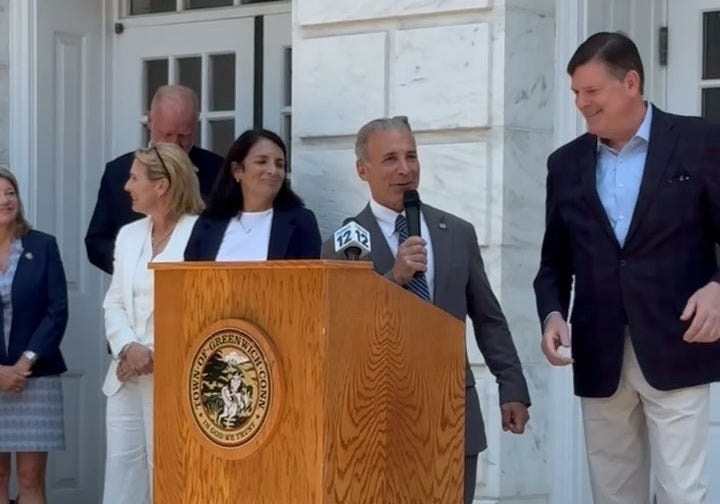
The speakers at the presser included Fazio, State Rep Tom O’Dea of New Canaan, and State Rep Tracy Marra of Darien and Norwalk, who’s the ranking member on the Energy and Technology Committee. Fazio had his own story of what started this: “some private entities trying to expand access to housing, and they’re just not capable of doing it because of the lack of infrastructure, especially around gas.”
So now there are two origin stories, Fazio’s private entities and the newsletter’s neighbors, and neither names a project. The event drifted from there. Marra went into solar and grid reliability, while O’Dea called for more nuclear, more natural gas and went after the public benefits charge. These are real debates, but they’re regarding Connecticut energy policy more generally. None of them answers whether CNG can actually service new construction in Greenwich.
When Con Edison hit an actual gas capacity limit in Westchester County in 2019, it declared a formal moratorium on new hookups, in public filings, and stalled thousands of housing units. CNG has announced nothing like that. Its statement describes reinforcement planning but not service restrictions.
Camillo’s demand asks the legislature to freeze zoning mandates in 168 towns that he doesn’t represent. It’s also based on a problem documented only in Greenwich and only in part. The most useful result of this is the September forum Camillo says he’s planning with CNG, Aquarion and Eversource at Town Hall in Greenwich, which would put utility execs on the record in public.
Until then, the demand sits with the Governor and the state legislature.