


Google announced that the old deal is over for publishers.
At Google I/O last week, the company revealed one of the biggest rebuilds of search in a generation. The search box will no longer just be a path to the web. It’s becoming the web: conversational answers, agents and generated interfaces that live inside Google.
For users, this may seem convenient. For publishers, it’s something closer to a platform obituary.
For 20 years, Google search has been the backbone of the internet. Publishers didn’t love every part of the deal, but the deal worked. You built a website, you wrote stuff people wanted to read, people found you on Google.
That was the deal.
A decade ago, the typical content site would get 30 to 60% of its traffic from Google search. The rest came from direct visits and social, mostly Facebook. The ratio was the foundation of nearly every business model in digital media.
I’ve seen entire newsroom strategies built around this math. Hiring and content plans, weekend coverage, SEO teams, live blogs, commerce, all of it started with the same assumption: Google, the heart of the open web, would keep sending readers.
Then Facebook cut off the social fire hose.
After the 2016 election, Facebook gradually stopped sending publishers traffic. The reasons shifted year to year. First they said it was manipulation of link posts leading to election interference. Then it was the pivot to video, supercharged by metrics Facebook later acknowledged were inflated, but not before publishers laid off thousands of writers to chase it. Then it was algorithmic deprioritization of news articles that simply was never reversed.
By 2020, publisher referral traffic from Facebook was down 90% on average. It’s gone down since then, too.
The social platforms are now designed to keep you inside them. Their incentive is to never let you leave. Now, the same thing is happening with Google and it’s a much bigger deal.
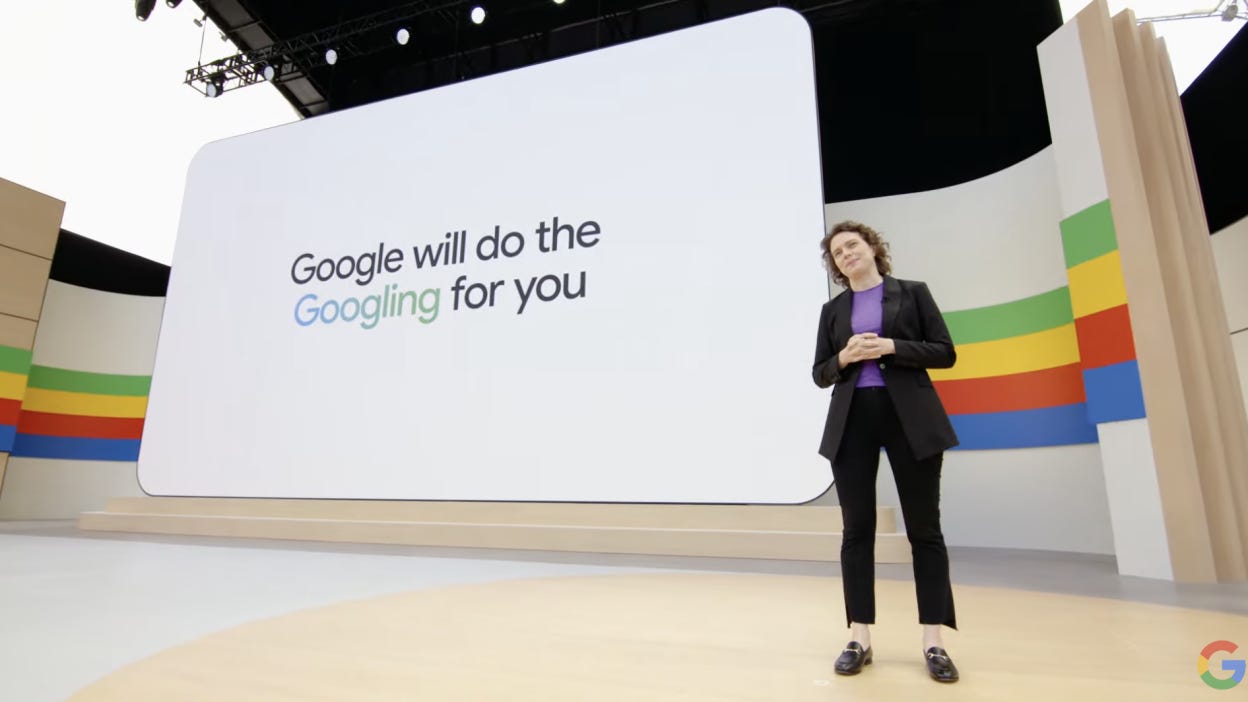
At Google I/O, the company described its new search update as the most significant change in 25 years. Users will get conversational answers, agents and new generative interfaces that will live inside Google. The traditional results page with blue links won’t be the product. Google is moving on.
Google will say this is better for users. In many ways, it will be. But when Google gives people the answer directly, fewer people click on the links to the sites that did the real work in the first place.
The web numbers for publishers were already brutal. Chartbeat covered 2,500+ news sites showing Google search referrals were down 33% globally year over year and over 38% in the US. Right now, 69% of searches are zero-click searches. The number is climbing.
Google Discover, the feed you see when you scroll down on Google mobile, is a remaining fire hose for many publishers. It’s not much better. It can deliver huge traffic but it’s brutal to build around. You’ll have a story that should work that does nothing. A throwaway post will catch fire. It rewards luck in the algorithm over audience loyalty.

One more detail worth sitting with: around the same time Google was rebuilding search in a way that would hollow out the publishers that feed the web, Sergey Brin was back in Alphabet’s orbit, leading a coding sprint at DeepMind.
Brin has relocated to the Nevada side of Lake Tahoe amid California’s proposed and likely doomed billionaire tax fight, which he donated $45M against. And now, by Donald Trump’s own description, he is dating a “really wonderful MAGA girlfriend.” Brin’s made no public case or comments for how Google’s AI search era is supposed to work for the publishers that built it.
While publishers are figuring out what happens next, one of the guys shaping the future of the internet is living in his completely different world.
There was no public process or industry listening tour. Just a handful of executives in Mountain View made the call.
So what happens now? Some publishers will adapt, others will fold. The ones that win will diversify by owning more of the relationship: newsletters, SMS, paid memberships, social content and franchises that people seek out, repeatable video formats, live events and other ways to activate the audience that a publisher already has. This is where innovation is right now.
Publishers will still take Google traffic. But they can’t build a business assuming that Google will keep sending readers. The old deal is done.
No Surprise. Enterprise network giant Lumen Technologies recently reported that AI bots now generate over 50% of global internet traffic. Blockchain based internet may offer publishers more visibility and protections from the scrapers....