


A year ago, someone on r/Connecticut posted a link to State Senator John Kissel’s Wikipedia page and asked a pretty simple question.
“So how is this legal?”
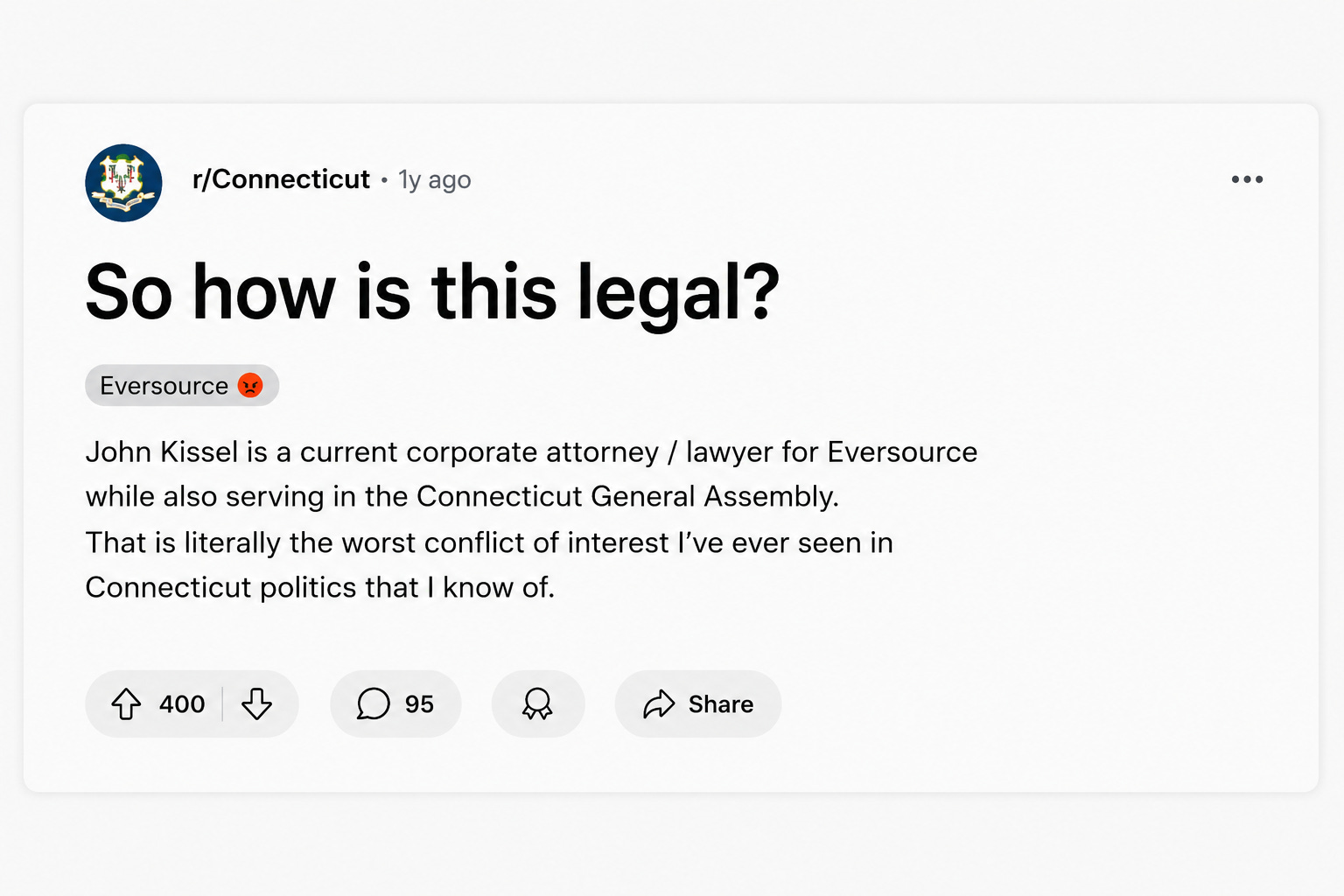
The reason for the question is obvious. John Kissel has been in the CT State Senate since 1993. He’s one of the most senior Republicans in the Capitol. He also happens to be a corporate attorney for Eversource, the monopoly utility that sends electric bills to most of CT.
It seems like the type of thing that should be illegal. Or at least the kind of thing that would trigger a new ethics rule. Eversource isn’t a random private employer. It’s the regulated utility that most Connecticut residents have to use. They lobby the legislature just as much as anyone. They fight with PURA (the state’s utility regulator).
So the Reddit question makes a lot of sense. How is this legal?
The state wrote it this way. Under CT’s ethics statute, a legislator only has a “substantial” conflict of interest when a piece of legislation would financially benefit the legislator, a family member or a “business with which he/she is associated.”
That sounds broad until you read the definition, a “business with which he is associated” doesn’t include a legislator’s regular employer.
And this is the whole ballgame.
If a lawmaker owns part of a company, directs the company or has specific leadership ties to it, that can create a conflict of interest. If the lawmaker just works at the company, the rule gets much softer.
This isn’t my take on it, either. 9 years ago, the Office of State Ethics told then State Senator George Logan that Aquarion, his employer, wasn’t technically a “business with which you are associated” under the law.

They said Logan could vote on legislation affecting Aquarion, as long as the bill didn’t directly put cash into his own pocket or the pocket of an immediate family member. They also said he could vote on budget, bond or tax packages even if they included things specifically benefiting Aquarion.
This is how Connecticut currently handles conflicts. The question isn’t whether your employer has major business before the state. It’s whether the vote creates a direct financial benefit to you personally. This is an extremely narrow standard.
Mark Pazniokas of the CT Mirror had the cleanest take on this in 2020: “Nothing in Connecticut’s narrowly drawn ethics rules bar legislators from voting on matters that help or harm their employers.”
Which brings us back to Senator Kissel.
It appears Kissel has been careful. He’s not on the Energy and Technology Committee, which would be a major conflict of interest. He does typically recuse himself from energy bills, even though he’s not required to do so.
In 2020, when a big storm hit and there was public anger over outages and rate increases, he voted for the utility accountability bill. “This doesn’t benefit my employer and my constituents spoke with one, loud voice, especially after the rates went up.”
This actually matters. This piece isn’t about how Kissel got caught doing something illegal. There’s no ethics finding or investigation that I’m aware of. He may well be acting in good faith.
But this is the crux of the problem. The system depends on him acting in good faith.
Senator Kissel is a senior member of the Regulations Review Committee, which reviews state agency regulations before they go live. That includes regulations from PURA, the agency that regulates Eversource.
So even if Kissel avoids the committee that writes Connecticut’s energy policy, he still sits near the machinery that turns PURA regulations into state rules.
Again, this is 100% legal and Kissel was not the only one.
From 2017-2020, 3 GOP senators had direct professional ties to Eversource or a subsidiary while serving in the legislature. As noted, Kissel works as a corporate attorney for Eversource. Kevin Witkos, then the deputy minority leader, worked for Eversource as a community relations specialist. Logan worked for Aquarion, owned by Eversource.
They weren’t sitting around killing bills. The point is more basic than that. Eversource had people in the building.
Democrats have their own versions of this too. This isn’t a story about one clean party and one dirty party. Eversource’s bench in Hartford has been mostly Republican, this is also true.
The question normal people are really asking isn’t whether every vote is dirty or whether every lawmaker is corrupt. They want to know if they can trust the system.
I don’t think they can, specifically when it comes to Eversource.
In 2023 and 2024, the company spent around $1.3M lobbying Hartford. Eversource and United Illuminating sued PURA Chair Marissa Gillett last year. The Eversource CEO announced $500M in Connecticut spending cuts the same morning Governor Lamont reappointed Gillett to PURA, blaming a hostile regulatory environment.
Lamont was spot on when describing the campaign against Gillett: “There’s a full-court press to get her out of there… I mean the lobbyists, the publicists, the lawyers.”
I’m not the first person to call all of this out. In 2020, Peter Lewandowski (then director of the Office of State Ethics) proposed requiring lawmakers to file a written disclosure when they voted on something affecting their employer. It didn’t even stop them from voting but at least it was something.
But even that bill died in committee.
Common Cause Connecticut has been trying for years to get the legislature to address this and tighten these rules… but the proposals go nowhere.
Massachusetts has a different standard. Their ethics law treats a business where a lawmaker serves as an employee as a potential conflict. So the thing Connecticut carved out, Massachusetts wrote in.
The Reddit user asked the right question. “How is this legal?” It’s because CT lawmakers made it legal and then they left it that way.
The next time your Eversource bill jumps, you can get mad at the company and the politicians who keep insisting that the system works.
But keep in mind that Connecticut has a system where a state senator can work for a monopoly like Eversource, sit close to the regulatory process and still be following the rules.
The rules are the problem.