


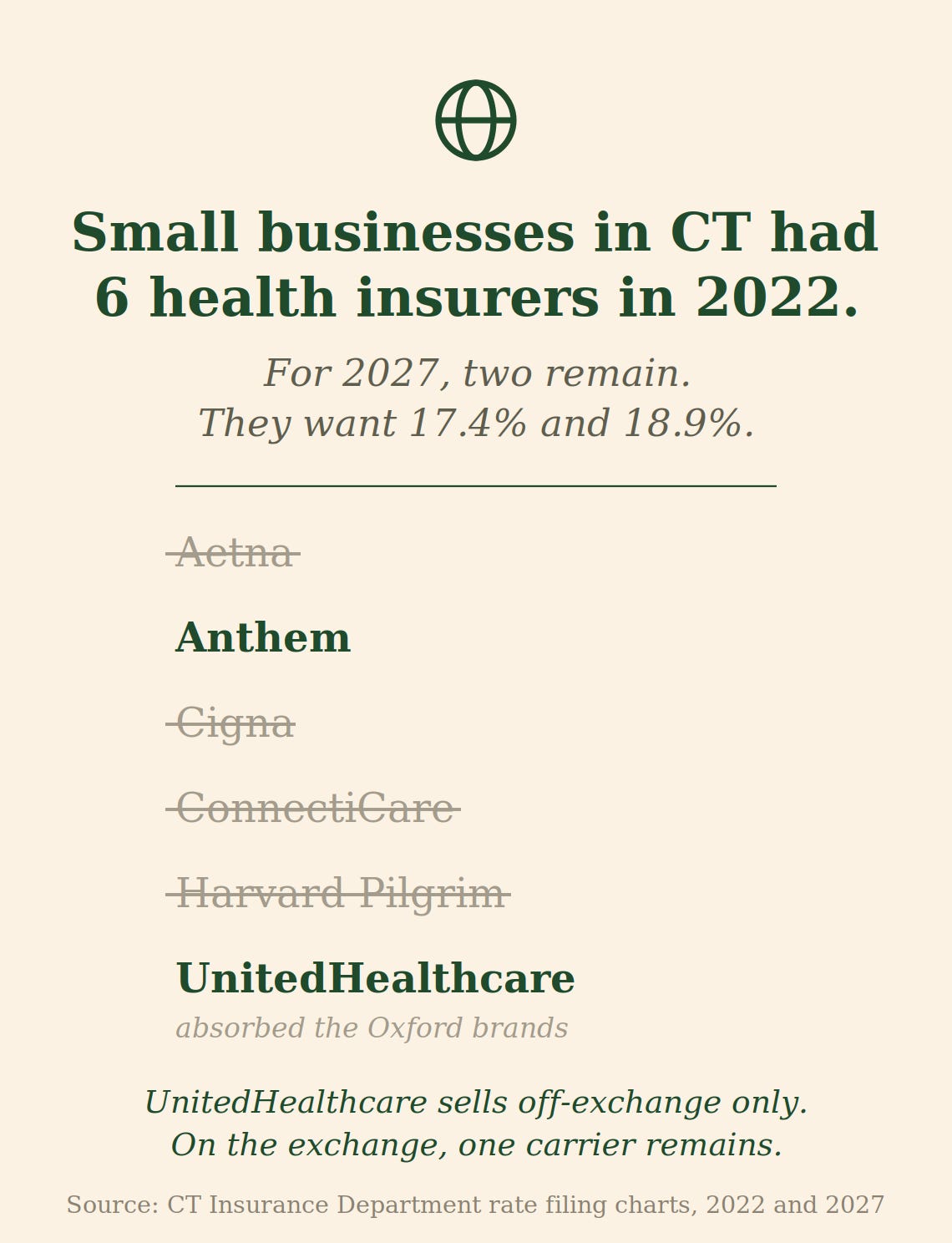
Small businesses in Connecticut are getting screwed by spiraling health care costs. If you were a small business owner looking for health care options in 2022, you would’ve had 6 options. Looking towards 2027, there are just 2.
It's actually even worse. Anthem wants a 17.4% increase for 2027 and UnitedHealthcare wants 18.9%. And UnitedHealthcare only sells "off the exchange," so if you shop on Access Health CT, Anthem is your only option.
This is what happens every summer. Insurers tell the state how much more they want to charge next year, and the Insurance Department decides how much of it they get. This year’s requests average around 16 to 18% and hit 220K people stuck in this market: small business employees, freelancers and people who retired before Medicare kicked in.
The big problem I see is that the state regulates the insurers who pay hospital bills but doesn’t address how much hospitals charge them. Even Insurance Commissioner Josh Hershman’s release listed hospitals and providers as responsible parties for the increases.
Comptroller Sean Scanlon runs the Connecticut Partnership Plan, the self-insured pool that covers nearly 75K municipal and school employees. He’s got a front row seat to this whole thing and I spoke with him last week.
I asked him: if provider prices are driving up premiums, isn’t the state’s process focused on the wrong part of the problem?
“Yeah, it is absolutely right.” In a market with such little competition, “the providers can charge whatever they want. The insurers have the ability to basically charge the customers whatever they want correspondingly.”
Commercial healthcare spending per person grew 25% from 2019 through 2023, while Medicare grew just 7% over the same period (it sets prices administratively). Connecticut’s hospital spending analysis found inpatient prices 27% more than the national median in Hartford… it’s 40% above it in Bridgeport and New Haven.
Scanlon’s plan provides a real life test of how powerful public purchasing can be. The results, so far, are mixed. Towns and school boards in the state keep joining with 187 groups now vs. 153 just 2 years ago. Guilford, Scanlon’s hometown where his wife, Meghan Scanlon, is on the board of finance, just saw a 35% increase this year.
The state plan also lost money last year. Its FY25 report shows $731.4M in claims against $706.8M in premiums, a $24.6M gap. Scanlon blames rising medical costs, the same explanation the insurance companies give in their rate filings.
One other thing to note: the state plan uses Anthem’s network and Anthem negotiates the hospital contracts. What members of the plan paid hospitals compared to those on an Anthem commercial plan isn’t public. “Every health plan in America, like I said, is dealing with this,” Scanlon told me.
A program called FlyteHealth shows what can be done when you can’t control the underlying price of a drug. In July, the Comptroller’s office announced that the GLP-1 and weight management program had saved an estimated $29.7M in drug costs. An analysis says the program cost $32 net per participant each month in year 1 (a return of 77 cents on the dollar). The $29.7M is an estimate of what they avoided spending, based on what the state would have paid if patients had been prescribed Wegovy, which costs over $1K a month, instead of Ozempic which costs around $350, even though they’re essentially the same drug.
The cheaper option was available because Flyte providers were allowed to prescribe diabetes-labeled drugs even if they didn’t have a diabetes diagnosis. The state's actuary didn’t include these savings in its ROI calculation. For Scanlon, the point is bigger than the short term drug cost savings. This program pairs the medication with mandatory lifestyle management and he argues that “money we spend now to help these people is money we save in triplicate” later.

The state legislature spent last session rearranging the furniture around the big question: pricing. Scanlon helped broker a deal that gives hospitals more government cash in exchange for holding them accountable “for the first time ever with real teeth on the benchmark.”
Under the law, a hospital that goes over cost benchmarks might be forced to file an improvement plan that it can write itself. A monetary penalty, a one-time community project of $100K to $400K, applies only to hospitals that refuse the paperwork, beginning in 2029.
The law also made the benchmark much easier to hit. For 2028 through 2032, it rises to 3.9%, a full point above this year’s target and hospitals also can’t be flagged “based solely on commercial payment growth.” And surprisingly, the agency that ran the program was abolished.
The one benchmark penalty with real teeth behind it passed a year earlier and it points at the insurers. Starting in 2027, if a carrier’s rate increases have exceeded the benchmark 2 years in a row, the insurance commissioner can cut its next request by up to 2 points.
So a company like Anthem, which pays hospital bills then passes them along, can lose money for exceeding the benchmark. A hospital system that sets the prices that Anthem and other carriers pay can exceed that same benchmark, write its own improvement plan, on a timeline that the legislature just made more favorable to them, with a penalty that only hurts if they skip filling out paperwork, starting in 2029.
One fix on the table is Governor Lamont's Connecticut option. Scanlon is one of the people building it. He described it to me as small businesses and nonprofits buying "into the plan that I run," the version he's pushed since 2019 as a state rep. The proposal the governor unveiled in March is different: designed by the state but run by private insurance co’s who carry the risk. Scanlon calls it a "cousin" of the Colorado option. Colorado’s own analysis of the program found lower premiums and about 15% less out of pocket costs, although insurers there repeatedly missed the plan’s price targets.
Towards the end of the call, I asked what I see as the central question: Nobody seems to have the authority to do anything about the real problem, hospital prices. Scanlon answered with Maryland, the one state that sets hospital prices directly.
“Maryland, for example, does essentially price controls. So that’s sort of one end of it from one side. And then doing nothing is the other. I’d say a cost growth benchmark is sort of a middling path. I think it’s worth having conversations about whether we should move closer to the Maryland model if this doesn’t work.”
Nobody in Connecticut thinks the comptroller’s office is Sean Scanlon’s last public job. When a top elected official with that kind of future says price controls could belong in the conversation, I start to listen. The stakes are getting bigger.
The good thing is that none of this is a done deal. You can write the Insurance Department at cid.ratefilings@ct.gov until August 24. The public hearing is on August 26th in Hartford. The state will then decide in September.