


This summer, 100 residents chosen through a lottery will sit down to work out how Connecticut should pay for schools, roads and police. Not legislators or lobbyists but regular people, paid $1,200 for their time.
It’s called the Connecticut Citizens’ Assembly on Property Taxes, led by Comptroller Sean Scanlon’s office and the CCM (Connecticut Conference of Municipalities), in partnership with Yale and UConn.
The final panel was selected this week and the state used the lottery to pick them. At CT Lottery headquarters, officials loaded numbered balls into the machines they use for the nightly draws. UConn’s team mailed 240K letters at random and around 2,300 people responded showing interest.
A second survey verified who was actually around to do it and 1,570 remained. From that they built panels of 110, balancing homeownership, geography and whether people have kids, which generated 50 million possible combinations. Almost 10K of those matched the state’s demographics and 40 were randomly picked as finalists. Each got a ball and the machine ran for 30 seconds. It spat out number 29.
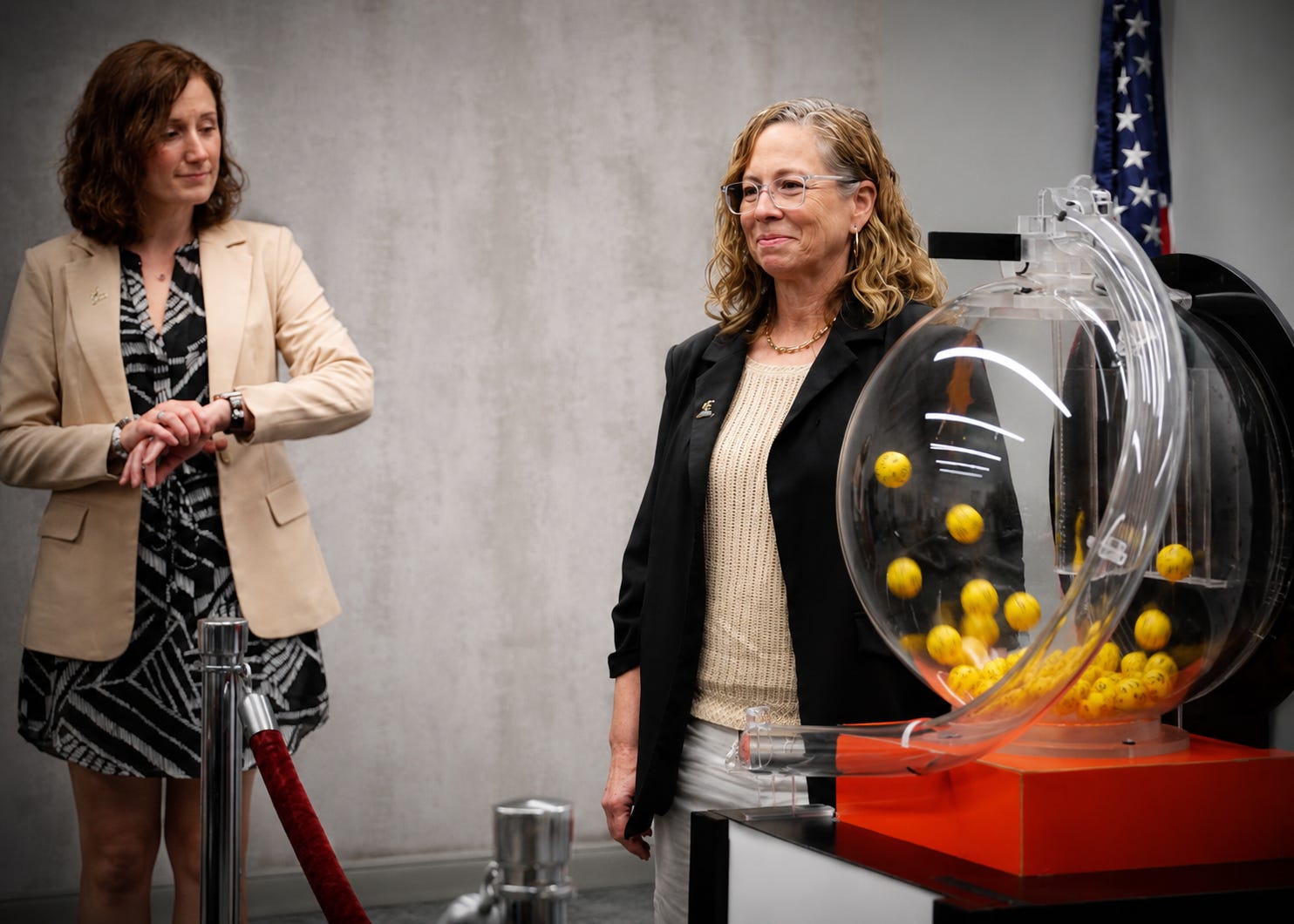
So panel 29 is the assembly, with 110 people all in. 100 members and 10 alternates just in case people drop out. The 100 members will meet over 6 sessions this summer with recommendations due in the fall. Assemblies like this have run in the US before. Petaluma, California used one in 2022 to figure out the future of its fairgrounds. The city adopted the plan. But nobody has tried this at the state level and on a question this large.
And they’re trying to solve a hard problem. Connecticut bars its towns from taxing income and local sales. They live and die on the property tax, which covers around 70% of the average town’s revenues. What a homeowner pays depends on the town’s grand list, the total value of everything taxable within its town limits.
Hartford’s grand list is thin, so it sets a high mill rate to collect what a wealthier town can collect at a much lower rate. Back in 1977, in Horton v. Meskill, the state Supreme Court ruled that the way Connecticut’s schools were funded violated the state constitution due to disparities tied to local property values. The legislature has been tinkering with the formula ever since without touching the dependence part.
Over the last 50 years, every property tax reform runs into the same question: who’s the loser? More aid from the state equals higher spending. Revenue sharing means some towns get less than they get now. Local-option taxes just shift the burden elsewhere. The state has spent decades arguing over tradeoffs and hasn’t settled on anything.
The assembly’s job isn’t to find a solution that hasn’t been debated already. It’s to figure out which tradeoff the rest of us are willing to live with (or what a representative group of residents is willing to live with). This is the case for an assembly. These residents aren’t running for office and have no constituencies to protect. They weigh the tradeoffs out in the open.
The idea didn’t start in Hartford. It started with Hélène Landemore, a Yale political scientist who for years has argued, most recently in her book Politics Without Politicians, that randomly selected citizens can handle hard questions we usually hand to professionals.
They just need time, good information and a structured process to deliberate. Random selection protects diversity of thought, which elections can filter out. Connecticut is now her largest American test.
This method is older than the country. UConn professor Michael Morrell, who designed the selection, highlighted how the ancient Greeks selected citizens by lot to serve on councils and juries.
Connecticut’s design reads like an answer to the hardest lesson from Landemore’s research. In Iceland, ordinary citizens helped draft a proposed constitution that won broad support in a 2012 referendum. Parliament never enacted it. The process had public legitimacy, but not enough support inside the institution responsible for solidifying it into law.
This version runs through the system on purpose. It is being pushed by the comptroller’s office and backed by the organization that represents the state’s towns.
Comptroller Sean Scanlon has promised to carry the assembly’s recommendations into the legislature. At the drawing, he was blunt about why previous efforts to address property taxes died: legislators feared that if they cast the hard vote, the public wouldn’t have their back. This is built to close that gap. A recommendation from 100 ordinary people gives legislators something property tax reform has never had: cover.
The money is private, not state money: It’s being financed by a mix of Connecticut foundations, civic groups and individual donors.
Citizen assemblies don’t write the actual laws. Their value is narrower than that and real. They shed daylight on the tradeoff and make a room of strangers own it. If 100 strangers can crack the code on property taxes, they’ll hand Connecticut a template for how to tackle more issues that the legislature has let linger for decades.
There's another wrinkle I'll dig into later: organizers say they'll use AI to connect the assembly's deliberations with more than 10% of the state's population.
More to come on this. I’ll be following the sessions over the summer.