


I first met Sean Scanlon about 16 years ago when I was working on Ned Lamont’s 2010 campaign for governor. Lamont lost that race but today he’s governor and running for a third term. Scanlon was working for Chris Murphy, who was still in the House at the time and a few years away from the Senate. We were both young and pretty far down the food chain in CT Democratic politics.
A lot has changed since then.
Sean is now Connecticut’s Comptroller, the state’s CFO and one of the first millennials elected to statewide office here. I’ve spent the last decade working inside digital media and the platform economy watching how Big Tech reshapes industries from the inside.
My experience is part of why I wanted to talk to him. Sean’s office has been quietly doing some of the most interesting work in the state right now on a question I think about every day.
What happens to Connecticut’s economy when AI starts hitting the industries we depend on?
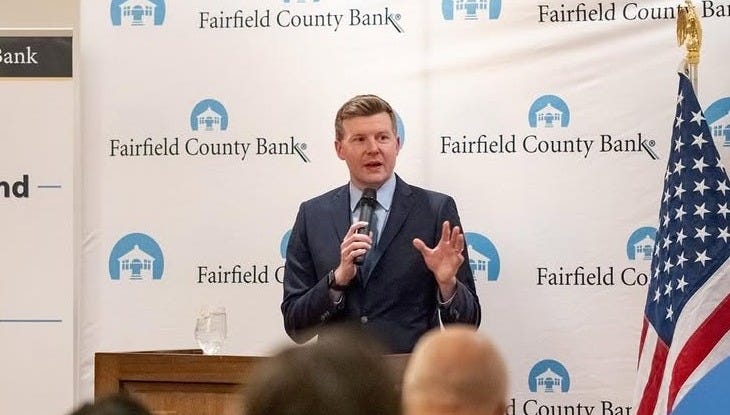
The answer, based on the convo I had with Sean, is that the shift is already underway. Most people just haven’t processed what it means yet.
The immediate picture has enough chaos on its own. Tariffs bouncing around. A war in Iran pushing energy costs even higher. The state’s surplus shrinking faster than expected. Sean spends a lot of time talking with businesses that can’t plan more than a few weeks ahead.
“I spoke to a big employer last week who said their world was rocked by the original Liberation Day tariffs,” he told me. “They changed all their supply chains. Then boom this happens. Now they have no idea what to do strategically because the fate of these things is so up in the air.”
People are feeling this instability directly. Gas prices have jumped since the war started and heating oil has climbed by more than a dollar a gallon in some places. But underneath the daily whiplash, something bigger is happening.
CT ranks 9th nationally in employment directly affected by AI. The sectors most exposed, insurance, health care, finance and higher ed, are not just industries here. They’re a tax base. When those industries change, CT changes.
Sean’s office has been looking at this closely. The way he frames it cuts through a debate that usually gets stuck in abstractions. People tend to ask whether AI will replace jobs or simply make workers more productive.
Sean thinks that question misses the point.
“I don’t know that we have all the answers. But that replace versus augment question is probably a thin line. And I think it is our job to plan for both realities, not one or the other.”
“You can live in your parents’ basement and pay your student loans and you can have a job at Travelers,” he said. “But if you don’t have the job at Travelers you are just living in your parents’ basement with a lot of debt working suboptimal jobs for the debt ratio you have.”
The first rung of the ladder matters a lot more than people realize. When it weakens, a lot more starts to wobble.
It’s not hard to imagine where this goes. More skepticism about college. More pressure on universities whose business models are already shaky. A long overdue shift towards workforce training that doesn’t require a 4-year degree.
Then there’s the infrastructure problem. AI data centers use an insane amount of electricity. They consume electricity equivalent to about 100K homes. Some of the newest facilities require even more than that.
CT’s notoriously high electricity prices may have slowed the rush of these projects starting here. Sean mentioned it with almost a laugh. The same energy bills that piss off residents every month have accidentally shielded the state from some of the pressures other states and regions are already dealing with.
But this won’t last.
“They will come and they are coming because the world is heading in this direction,” Sean said. “I just think we need to be more thoughtful about it.”
Sean pointed to the work state senator James Maroney has been doing on AI policy as the kind of approach that makes sense. Not banning the new technology. Not pretending it can be stopped. But setting legitimate and thoughtful rules for how it arrives.
Near the end of our conversation, I asked Sean what people in CT aren’t paying enough attention to.
“60-70 years ago a town’s value was if they had a giant factory with a smokestack that employed a thousand people. Now in some office park three workers could be working on something that changes the world generating massive amounts of GDP that nobody knows about.”
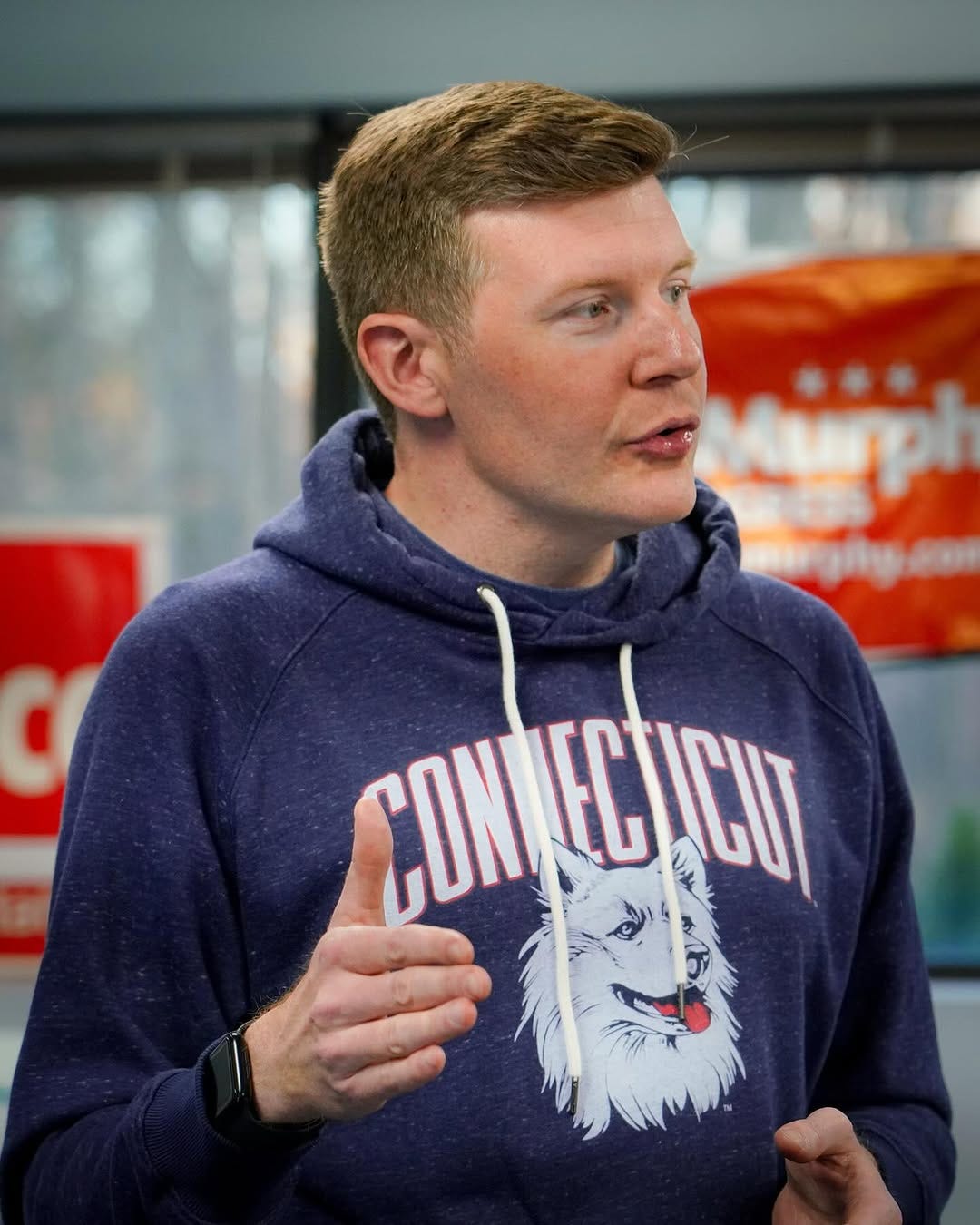
This gets at something easy to miss about the modern economy. The places creating the most value often don’t look like the big employers people still imagine when they think about the economy.
These days a small team in a quiet office park (sometimes even a solo entrepreneur) ends up building software that shapes entire industries.
A lot of what people still picture when they think about CT’s economy doesn’t look like that. But more and more of what matters does. This disconnect matters politically.
If leaders are still planning for the economy people remember vs. the one that’s forming in front of all of them, they will keep solving yesterday’s problems.
Sean believes CT may finally be in a position to think about the future differently.
A decade ago, the state was dealing with a debt and budget crisis. The last 10 years have been about digging out of that hole, one day at a time. Now, roughly $10B in debt has been paid down. The rainy day fund is bigger than anyone could’ve anticipated.
“We spent the last ten years getting out of a fiscal mess,” Sean said. “For the first time we are above water and we can do innovative things.”
For the first time in a long time, CT has some room to think beyond the next fire drill.
This doesn’t guarantee success but it does mean CT has something it has not had in years: the ability to think about where the economy is going before it gets there.
AI adoption is accelerating rapidly and hiring trends are already shifting. Big decisions on electricity infrastructure and data centers will shape our grid for decades.
CT spent the last 10 years proving it could stabilize the state’s finances. The next decade will test something harder.
Can the state recognize the economy forming around it before it is too late to shape it? Based on this conversation at least one statewide officeholder is taking that question seriously.
The state could use a few more.
Great article. Forward thinkers like Sean will be the winners.